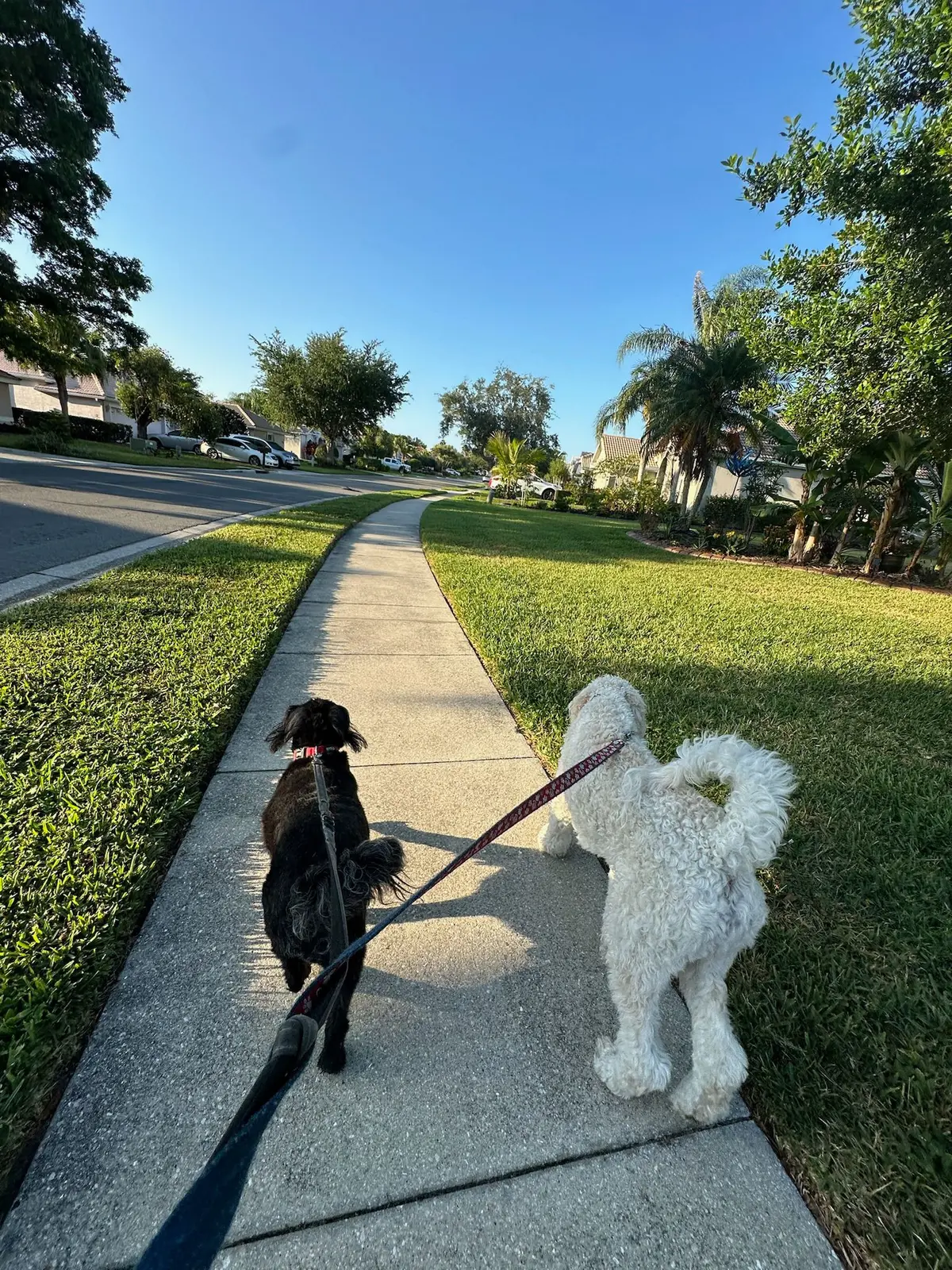
Why Sarasota's Climate Is Uniquely Demanding for Dogs
Florida's Gulf Coast doesn't just get hot — it gets humid. Sarasota sits at roughly 27° north latitude, which means intense solar radiation from May through October. But the real danger isn't air temperature alone: it's the combination of heat, relative humidity (which routinely reaches 80–95% in summer), and radiant heat radiating off pavement that creates a triple threat for dogs on walks.
Unlike humans, dogs cool themselves almost exclusively through panting. Panting works by evaporating moisture from the tongue and respiratory tract — a process that becomes far less efficient when ambient humidity is already near saturation. On a 92°F Sarasota afternoon with 85% humidity, your dog's cooling system is working at a fraction of its normal capacity. What would be a manageable walk in a dry climate becomes a genuine medical emergency risk here.
Add ground heat to the equation: Sarasota's asphalt and concrete can reach 140°F to 160°F during peak afternoon hours in summer. At those temperatures, paw pad burns can occur in as little as 60 seconds of contact. This is why local professional dog walkers treat walk timing as a non-negotiable safety protocol — not a preference.
Summer Walk Timing: May Through October
During Sarasota's long summer season — which realistically runs from early May through late October — the window for safe dog walking shrinks dramatically. Use this color-coded guide to plan every outing:
The Pavement Temperature Test: The 5-Second Rule
Before every walk in warm weather, perform this simple test: press the back of your hand firmly against the pavement — not a light touch, but firm, sustained contact — and hold it there for a full five seconds. If you cannot comfortably keep your hand there for the entire five seconds, the surface is too hot for your dog's paw pads.
This isn't just a rough guideline. The back of your hand is approximately as heat-sensitive as a dog's paw pad. If it hurts you in five seconds, it will burn them. The test works on every surface: asphalt, concrete, brick pavers, composite decking, and sand.
In Sarasota from June through September, asphalt typically fails this test from around 9:30 a.m. until at least 7:00 p.m. — sometimes later on clear, sunny days with no cloud cover. Even surfaces in partial shade can be dangerously hot because of radiant heat bouncing off surrounding structures and pavement.
When pavement fails the test, your options are: walk exclusively on grass and dirt paths, use quality heat-rated dog booties, or simply wait for the evening window. Booties can be effective, but many dogs resist wearing them consistently — building an early morning walk habit is the most reliable and sustainable solution.
Winter Walk Timing: November Through April
Sarasota's winter season is genuinely wonderful for dog walking. Temperatures typically range from the low 60s to the low 80s, humidity drops significantly, and pavement temperatures stay comfortable throughout most of the day. This is when you and your dog can finally enjoy the longer, more relaxed walks that had to be cut short all summer.
Best Winter Walking Windows
- 9:00 a.m. – 11:00 a.m.: The sweet spot for most of the year. Mild temps, morning dew burned off, comfortable humidity. Ideal for longer outings for all breeds.
- 3:00 p.m. – 5:00 p.m.: Also excellent from November through February. Afternoon temperatures rarely climb above 80°F during the heart of winter.
- Early mornings in December–January: Can be genuinely cool — occasionally dipping into the 50s. Short-coated breeds, small dogs, and senior dogs may appreciate a light jacket on colder mornings.
Even in winter, always check the forecast. Sarasota experiences unseasonably warm days in March and April when afternoon temperatures push into the high 80s. Treat those days exactly like early summer — shift walks to early morning or late evening and use the 5-second pavement test before heading out.
Walk Duration by Season and Breed
The right walk length depends on both the season and your dog's individual characteristics. These are the general guidelines followed at Wiggle Your Tail, adjusted for each individual dog based on observed heat response:
Summer (May–October)
- Healthy adult dogs — medium and large breeds: 15–20 minutes maximum, early morning or late evening only
- Brachycephalic breeds (French Bulldogs, English Bulldogs, Pugs, Boston Terriers, Shih Tzus, Pekingese): 10–12 minutes maximum; stop immediately at any sign of labored breathing
- Senior dogs (7+ years): 10–15 minutes; monitor closely for early warning signs even during the coolest windows
- Overweight dogs: 10–15 minutes; excess body mass significantly impairs heat dissipation regardless of breed
- Puppies under 6 months: 5–10 minutes; puppies have less efficient thermoregulation and tire far more quickly than adults
Winter (November–April)
- Healthy adult dogs: 30–60 minutes depending on breed energy level and individual fitness
- High-energy breeds (Labrador Retrievers, Golden Retrievers, Border Collies, Vizslas, Weimaraners): 45–90 minutes in cooler months; they've been cooped up all summer
- Senior or brachycephalic dogs: 20–30 minutes; far more latitude than summer, but still monitor for signs of fatigue
If Your Dog Overheats on a Walk
Even with careful timing, heat emergencies can happen. If your dog is panting heavily, drooling thick saliva, slowing down or seeking shade, stop the walk, get them into shade or A/C, offer small amounts of cool (not ice-cold) water and call your vet. For the full list of heatstroke warning signs and first aid steps, read our guide to keeping your dog cool in Sarasota summers. After hours, BluePearl Pet Hospital in Sarasota is open 24/7 at (941) 923-7200.
Building a Heat-Smart Walk Schedule
A good walk schedule in Sarasota changes with the calendar. A few habits make it easy:
- Check sunrise and sunset times weekly. In June, the cool window can open before 7 a.m.; by December you can walk comfortably at midday.
- Watch the heat index, not just the temperature. Humidity keeps a dog from cooling itself by panting. An 85°F morning at 90% humidity is harder on your dog than a dry 90°F afternoon.
- Plan around afternoon storms. From June through September, thunderstorms usually roll in between 2 and 5 p.m. Lightning and sudden downpours make that window a poor choice for walks.
- Keep a heat log. Note how your dog handles different times and temperatures. Brachycephalic breeds, seniors and dark-coated dogs often need a shorter window than you'd expect.
- Split long walks. Two 20-minute walks at dawn and dusk are safer in summer than one 40-minute walk.
If your schedule makes early and late walks hard, professional dog walking in Sarasota can cover the cool-hour slots for you.
Practical Tips for Sarasota Dog Owners
- Set your alarm earlier in summer. A 6:30 a.m. walk from June through September isn't optional — it's the window that protects your dog.
- Always carry water. Even on short summer walks, bring water and a portable bowl. Dehydration accelerates heat stress rapidly.
- Choose grassy routes whenever possible. Grass stays significantly cooler than asphalt — a shaded grass path can be 40–50°F cooler than adjacent concrete on the same block.
- Trim, don't shave. A dog's double coat provides insulation against both cold and heat. Talk to your groomer about appropriate warm-weather trimming for your specific breed before making drastic coat changes.
- Know your dog's individual risk factors. Dark-coated dogs absorb more solar radiation and overheat faster. Dogs on certain medications — including some heart and blood pressure drugs — may also be at elevated risk. Check with your veterinarian.